
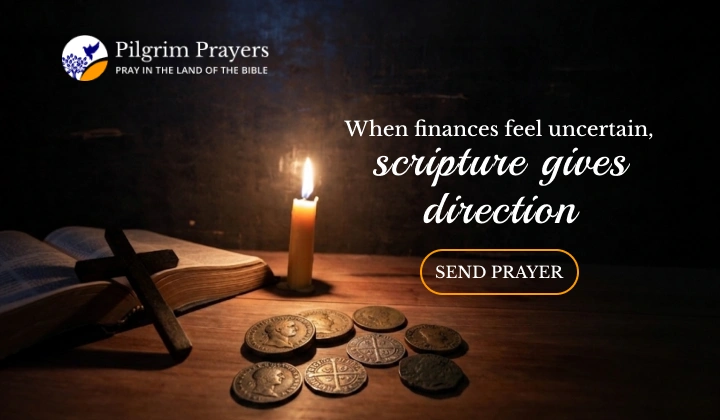
In times of financial struggle, turning to scripture can provide comfort, guidance, and strength. Praying for a financial breakthrough is not just about asking for money. It is about aligning our hearts and intentions with faith.
But there is a difference between reading these verses as inspiration and understanding what they actually meant to the people who first received them. Context changes everything. A promise made to a prisoner carries different weight than a promise made from a throne. A word that means strength and efficiency in Hebrew says something richer than a word that just means cash.
This post walks through five scriptures for financial breakthrough, each with its original historical context, a word study, a fill-in-the-blank prayer, and one practical faith-in-action step you can take today. You can also send prayer request submissions to the sacred sites of Jerusalem through Pilgrim Prayers, where each prayer is carried with care to places connected to faith, healing, hope, and restoration.
Biblical mindset vs. worldly mindset on finances
Before diving into the verses, this table shows where scripture invites a genuine shift in thinking. Most financial anxiety is rooted in a worldly framework. These verses speak a different language entirely.
| Biblical Mindset | Worldly Mindset |
| God is the source of all ability to produce wealth | Wealth is the product of my effort alone |
| Giving opens me to receive more | Giving when I am short is reckless |
| Seeking God first brings provision | Seeking provision first is the priority |
| Lack is an invitation to trust, not evidence of failure | Lack is evidence that God is absent or indifferent |
| My needs are known and held by a faithful Father | My needs are my responsibility alone to solve |
1. Philippians 4:19 – provision in abundance
“And my God will meet all your needs according to the riches of his glory in Christ Jesus.”
Historical context
Most people read this verse as a general promise. It is not. Paul wrote it from prison, likely in Rome, while awaiting a trial that could end in his execution. The Philippian church had just sent him a financial gift through Epaphroditus, risking considerable effort and expense to care for someone society had discarded. Paul’s response is not a motivational slogan. It is a testimony: the God who provides for me in a Roman prison will also provide for you. The promise carries the full weight of Paul’s personal experience of scarcity and divine supply.
Word study: Chreia
The Greek word translated “needs” is chreia, meaning necessary things, practical requirements, genuine lacks. Paul is not promising God will fund every desire. He is promising God knows and meets what is genuinely required. This is a precision promise, not a blank cheque.
Fill-in-the-blank prayer
Father, I bring You my specific need today: [write your need here]. I acknowledge that this is a genuine lack, not just a want. You know it fully. I trust You to meet it according to Your riches in glory, not according to my current circumstances. Amen.
Faith-in-action step
Write down one specific financial need, not a vague worry, but a concrete figure or situation. Pray over it by name this week. Specificity is an act of faith. It moves you from anxious worry to active trust.
Testimony
“I was a single mother with three weeks until eviction. I had prayed general prayers for years. When I finally wrote down the exact amount I needed and prayed Philippians 4:19 over that specific number, something shifted. Two unexpected payments arrived within ten days. I cannot explain it except through this verse.” A reader from Atlanta, Georgia
2. Malachi 3:10 – test his faithfulness
“Bring the whole tithe into the storehouse, that there may be food in my house. Test me in this,” says the Lord Almighty, “and see if I will not throw open the floodgates of heaven and pour out so much blessing that there will not be room enough to store it.”
Historical context
Malachi was written to a post-exilic Jewish community, people who had returned from Babylon to a ruined homeland and were rebuilding under severe economic hardship. They were withholding tithes not out of greed but out of scarcity: they simply did not have much. God’s challenge to “test me” was made to people who had genuine reasons to be cautious. This is not a prosperity gospel verse for the comfortable. It is a challenge issued to people who were already struggling.
Word study: Arubbot
The phrase “floodgates of heaven” translates the Hebrew arubbot hashamayim, literally the windows or lattices of the sky, the same imagery used in Genesis 7 for the flood. This is not a trickle. The image is of a dam opened completely. The scale of the promised response is deliberately overwhelming.
George Muller: a historical case study
George Muller ran orphanages in Bristol, England in the nineteenth century without ever making a public financial appeal. He fed thousands of children on nothing but prayer and an unwavering conviction that God would provide. On multiple documented occasions, the orphanage had no food for breakfast, and Muller prayed with the children before empty tables. Within hours, unannounced donations of bread, milk, and provisions arrived from strangers. Muller gave generously and systematically, testing God in exactly the way Malachi 3:10 describes, and recorded over 50,000 specific answers to prayer across his lifetime.
Fill-in-the-blank prayer
Lord, I confess that I have held back from giving because I was afraid. Today I choose to trust You with [my tithe / a specific gift / a first step of generosity]. I am taking You at Your word. Open what only You can open. Amen.
Faith-in-action step: the blessing fund
This week, set aside a small, fixed amount, even one percent of what you receive, into a separate envelope or account you label your Blessing Fund. The amount is not the point. The decision is. You are beginning to practice the posture Malachi describes, giving before you feel you can afford to.
3. Matthew 6:33 – seek first
“But seek first his kingdom and his righteousness, and all these things will be given to you as well.”
Historical context
Jesus spoke these words as part of the Sermon on the Mount, addressing a rural Galilean crowd, most of whom were subsistence farmers, day laborers, and fishermen. Financial anxiety was not abstract for them. It was about whether there would be food tomorrow. Jesus was not speaking to people of comfortable means who needed to reprioritize. He was speaking to people for whom tomorrow was genuinely uncertain, and telling them that the God who clothes wildflowers and feeds birds holds their future.
Word study: Proton
The Greek word translated “first” is proton, meaning first in order of priority, before all else. Jesus is not saying ignore your finances. He is describing a sequence: get the order right, and the provision follows. The promise is conditional on the sequence, not on circumstances.
The five-minute morning reorder
Before checking your bank balance, your emails, or your financial news feed each morning this week, take five minutes to do the following:
- Read Matthew 6:33 aloud once.
- Name one thing about God’s character that you are grateful for.
- Bring one specific financial concern to God by name.
- Declare: “I seek Your kingdom first today. The rest is in Your hands.”
This is not a formula. It is a reordering of attention, which is what Jesus was describing.
Fill-in-the-blank prayer
Jesus, I confess that I have put [this specific worry] before You this week. I choose now to put You first. I trust that as I align with Your kingdom, You will attend to what I cannot control. Help me keep the order right today. Amen.
4. 2 Corinthians 9:8 – generosity and abundance
“And God is able to bless you abundantly, so that in all things at all times, having all that you need, you will abound in every good work.”
Historical context
Paul wrote this to the Corinthian church in the context of a specific collection for the poverty-stricken believers in Jerusalem. The Corinthians had promised to give but had been slow to follow through. Paul is not writing a general theology of prosperity. He is encouraging a church that had made a commitment and needed courage to keep it. The promise of abundance is given as a reason to give, not as a reward for already being wealthy.
Word study: Autarkeia
The Greek word translated “all that you need” is autarkeia, the same word the Stoic philosophers used for self-sufficiency. But Paul gives it a radically different meaning: not independence from others, but contentment and completeness that comes from God’s provision. It is not “you will have everything you want.” It is “you will lack nothing you need for the work God calls you to.”
Fill-in-the-blank prayer
Father, I believe You are able, even when my circumstances say otherwise. I ask for autarkeia, completeness and contentment, not just abundance. Give me what I need for the work You are calling me to, and make me generous with it. Amen.
Faith-in-action step
Identify one person or cause you could help this week, even with something small. A meal. A message. A shared resource. Generosity is a practice before it is a feeling. Begin the practice.
5. Deuteronomy 8:18 – remember the source
“But remember the Lord your God, for it is he who gives you the ability to produce wealth.”
Historical context
Moses spoke these words to Israel on the edge of the Promised Land, after forty years in the wilderness. He was warning them about the specific spiritual danger of prosperity: forgetting God when things go well. The word “remember” in Hebrew carries the sense of active, ongoing recollection, not a one-time acknowledgment. Moses knew that abundance is often more spiritually dangerous than scarcity. This verse is not primarily a poverty verse. It is a prosperity warning.
Word study: Chayil
The Hebrew word translated “ability to produce wealth” is chayil. This same word is used elsewhere in the Old Testament for military strength (Exodus 14:28), moral virtue (Ruth 3:11, where it describes Ruth as a woman of “noble character”), and administrative capacity (Exodus 18:21). Chayil is not the ability to accumulate cash. It is God-given competence, strength, character, and efficiency. When God gives you the chayil to produce wealth, He is giving you your mind, your skill, your resilience, and your ability to work effectively. That reframes the prayer entirely: you are not asking for a windfall. You are asking God to sustain and sharpen what He has already placed in you.
Fill-in-the-blank prayer
Lord, I acknowledge that my ability to think clearly, to work skillfully, and to solve problems comes from You. I ask You to sustain my chayil today. Sharpen my mind. Strengthen my capacity. And keep me from forgetting You when the provision comes. Amen.
Faith-in-action step
Write down three abilities or skills you currently use to earn income or create value. For each one, write the words: “God gave me this.” This is not positive thinking. It is the reorientation Moses was describing, moving from self-reliance back to grateful dependence.
Historical case study: Bezalel
In Exodus 31, God tells Moses that He has filled a craftsman named Bezalel with the Spirit of God, with wisdom, understanding, and knowledge in all kinds of crafts, specifically to build the Tabernacle. Bezalel’s artistic skill and technical ability are explicitly described as gifts from God’s Spirit. Chayil is not just about money. It is about the God-given human capacity to create, build, and produce. That capacity is worth praying over.
Praying through financial hardship in 2026
These verses were not written in stable economic times. They were written during imprisonment, exile, post-war reconstruction, and wilderness wandering. That is worth noting in 2026, when inflation, rising costs of living, housing instability, and economic uncertainty are pressing on millions of households.
The Bible does not offer a prosperity gospel that removes financial difficulty. It offers something harder and more durable: a theology of provision that holds in difficulty, a God who is present in scarcity and not only in abundance, and a call to a different kind of trust than our economy trains us to practice.
If you are navigating inflation, job insecurity, debt, or the anxiety of a digital economy where income feels unstable, these five verses speak directly into that reality. Not with platitudes, but with historically grounded promises from a God who has met His people in far worse conditions than the ones we face.
Finding strength in prayer
As you meditate on these verses, consider incorporating them into your daily prayers. Each verse holds unique promises that can inspire hope and strengthen your faith.
If you are looking for more ways to pray for financial breakthrough and strength, read the companion post: From Lack to Abundance: 5 Prayers for Financial Growth and Stability.
Sending your prayer to the Holy Land

At Pilgrim Prayers, we understand the weight of these prayers. We can help you send your prayer requests for financial breakthrough to the sacred sites of the Holy Land, including the Church of the Holy Sepulchre, the Basilica of the Agony, and the Abbey of the Dormition.
By sharing your prayers from these ancient sites, you connect deeply with the faith of those who prayed for provision long before you. Let us carry your prayer to the Land of the Bible.
Send your prayer for financial breakthrough today. Your prayer will be personally carried to the sacred sites of the Holy Land. Free. Sacred. Real.
Frequently asked questions
1. What does chayil mean in Deuteronomy 8:18?
Chayil is a Hebrew word with a broad range of meaning: strength, ability, efficiency, virtue, and military capacity. In Deuteronomy 8:18, it refers to the God-given ability to produce wealth through competence, skill, and character, not just financial fortune. The same word is used to describe a woman of noble character in Proverbs 31:10 and Ruth 3:11. Praying for chayil is praying for God to sustain and sharpen the capacities He has already placed in you.
2. Was Philippians 4:19 written as a general promise for all Christians?
Not originally. Paul wrote it specifically to the Philippian church in response to their generous financial gift to him while he was in prison. It is a personal testimony rooted in lived experience of scarcity and provision. Most theologians do extend it as a general promise to believers, but understanding its original context adds significant weight: this is a promise made by someone who knew exactly what it meant to have nothing and still see God provide.
3. Does the Bible promise financial prosperity to all believers?
No. The Bible consistently promises provision for genuine needs (Philippians 4:19), sufficiency for the work God calls us to (2 Corinthians 9:8), and God’s presence in hardship. It does not promise that all believers will become financially wealthy. Many of the most faithful figures in scripture lived in poverty or scarcity. The prosperity gospel, which teaches that faith always produces material wealth, is not supported by the full witness of scripture.
4. What is the best Bible verse to pray for financial breakthrough?
There is no single best verse, because different situations call for different promises. Philippians 4:19 addresses specific practical need. Deuteronomy 8:18 addresses the source of ability. Matthew 6:33 addresses priority and anxiety. Malachi 3:10 addresses generosity and trust. 2 Corinthians 9:8 addresses sufficiency for good works. Reading all five in context gives a far richer picture than any single verse alone.
5. How do I pray these verses effectively?
The most effective approach is to move from general prayer to specific prayer. Name the need, the amount, the situation. Identify which verse speaks most directly to your current circumstance. Use the fill-in-the-blank prayers in this post as starting points, then add your own words. And pair prayer with one concrete action, even a small one. Faith without works is described in James 2:17 as dead. Prayer combined with an act of trust, giving, reordering your morning, writing down your chayil, is far more than prayer alone.