
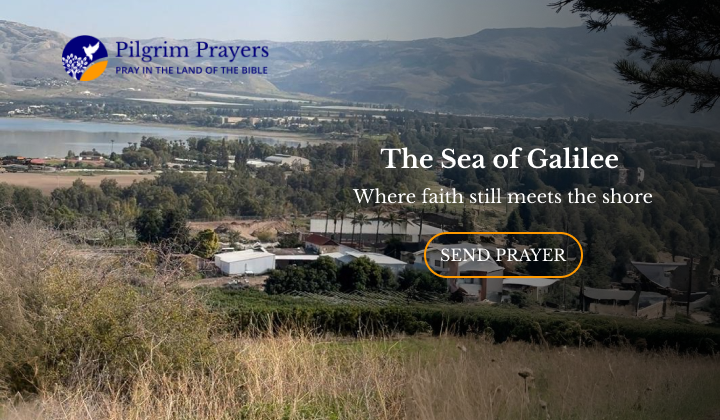
The Sea of Galilee is still there.
That might sound obvious. But when you’ve read about it your whole life, in Sunday school, in Scripture, in songs, it’s easy to forget that it’s a real place. Not a painting on a church wall. Not a word on a page. A real lake, with real water, surrounded by real hills where real people wake up every morning and go about their lives.
Jesus walked along this shoreline. He called Peter, Andrew, James, and John from their fishing boats right here (Matthew 4:18-22). He calmed the storm on these waters (Mark 4:39). He fed five thousand on these hills (Luke 9:10-17).
And today, the fishermen are still here. The hills are still green in spring. The water still catches the light at sunset in a way that no photograph can fully hold.
This is not ancient history. This is a living land.
Where faith meets daily life
A few kilometers south of the Sea of Galilee sits Kibbutz Degania, the very first kibbutz, founded in 1910. For more than a century, families have farmed this land, raised children here, and built their lives along the same shores where the disciples cast their nets.
To the east rise the Golan Heights. Green, wind-swept, and vast. From up there, you can see the entire Sea of Galilee spread below you, just as it was two thousand years ago. The landscape has not changed. The same basalt stones line the paths. The same wildflowers push through the soil every spring.
People live here. They harvest olives. They pour coffee in the morning and watch the mist lift off the lake. They drive their kids to school on roads that follow the routes Jesus walked.
This is what makes the Holy Land different from any other place on earth. It is not a museum. It is home.
Seeing it through Uri’s eyes
In this week’s video, Uri takes us through northern Israel, along the shores of the Galilee, past the fields of Degania, and up into the Golan. He speaks about what it means to live in a place that the rest of the world reads about in Scripture.
“Those lakes, rivers, hills, houses,” Uri says. “These are real places where real people lived and walked today and 2,000 years ago.”
For believers who may never have the chance to visit, Uri’s words offer something powerful: a reminder that the places you pray about are not far away or long ago. They are here. They are now. And people are living in them every single day.
The prayer connection
When you send a Jerusalem prayer request through Pilgrim Prayers, it doesn’t travel to a museum or a monument. It travels to a place where life is happening, where faith is not a chapter in a history book but the fabric of daily existence.
The Sea of Galilee is not just where Jesus performed miracles. It’s where a fisherman pulls in his nets this morning. It’s where a family gathers for Shabbat dinner tonight. It’s where the sunrise still paints the water gold, just as it did when Peter stepped out of his boat and walked toward his Lord (Matthew 14:29).
Your evangelical prayer request belongs in this living, breathing place.
A place for your prayer
The Holy Land is real. The water is real. The stones are real. And your biblical site prayer, when placed here with care, becomes part of this unbroken thread of faith that stretches back more than two thousand years.
If there is a prayer on your heart today, it has a place here.
Not in a distant past. Not in a story. Here, where the land remembers, and where faith is still alive.
Whenever you’re ready, we’re here to carry your prayer.