
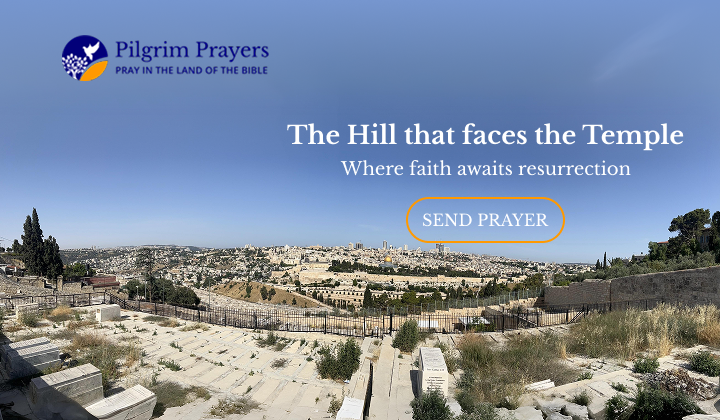
The graves begin almost at the top of the hill and stretch down, thousands of them, toward the valley below.
From here, the Temple Mount fills the horizon. You don’t need a map to understand why people chose to be buried here. They wanted to face it.
A brief walk along the Mount of Olives – where ancient faith meets living hope.
The Mount of Olives cemetery is the oldest Jewish burial site in Jerusalem. It has been here since the time of the First Temple, which means people have been laid to rest on this hillside for well over two thousand years.
But what makes this place extraordinary isn’t just its age.
It’s why people chose to come here.
For centuries, Jewish families across the diaspora, in Poland, in Yemen, in communities scattered across every continent, saved money to bring their loved ones’ bodies here. Not symbolically. Literally. Some families saved for decades. Some made sacrifices that their children only understood later.
They wanted to be buried on this hillside because of a deep, ancient belief: when the Messiah comes from the east, the dead will be raised, and those resting here, facing the Temple Mount, will be the first.
Faith made tangible in stone and soil.
For Christian pilgrims, this hillside carries its own weight.
This is the hill Jesus crossed on Palm Sunday, riding down toward Jerusalem as the crowds laid their cloaks on the ground before him. This is where he wept over the city. Not far below is the Garden of Gethsemane, where he prayed his hardest prayer the night before his death.
The Mount of Olives is where, according to the book of Acts, Jesus ascended, and where, in Christian tradition, he will return.
Standing here, the landscape of Scripture becomes a landscape you can touch, and where you can send your Mount of Olives prayer requests.
There is something that happens when you see this hillside for the first time.
It isn’t just the scale, the tens of thousands of graves, the centuries they represent. It’s the faith behind them. Every stone marks someone who believed something enough to stake their burial on it. To save for it. To arrange, from far away, to be brought here.
That’s not abstract faith. That’s faith with a body.
You may never stand on this hill in person. Many people never will.
But the prayers you carry, such as prayer for healing, prayer for peace, or prayer for the people you love, can reach this place. They can rest here, near these ancient stones, on this hillside that has held the hopes of believers for thousands of years.
You don’t have to be in Jerusalem to be spiritually present.