
A reflection for this week from the hills of Bethlehem
A woman stopped in the middle of Shepherd’s Fields and did not move for a long time.
She was not praying out loud. Not reading from a guidebook. Just standing in the open ground at Beit Sahour, a few kilometers from Bethlehem, her eyes on the hills to the east.
The guide waited. There was nothing else to do.
This is what the fields do to people.
In moments like this, many are reminded that prayer does not always need words. Some later choose to submit a prayer request, carrying that same quiet stillness into a shared act of faith.
In the stillness of Shepherd’s Fields
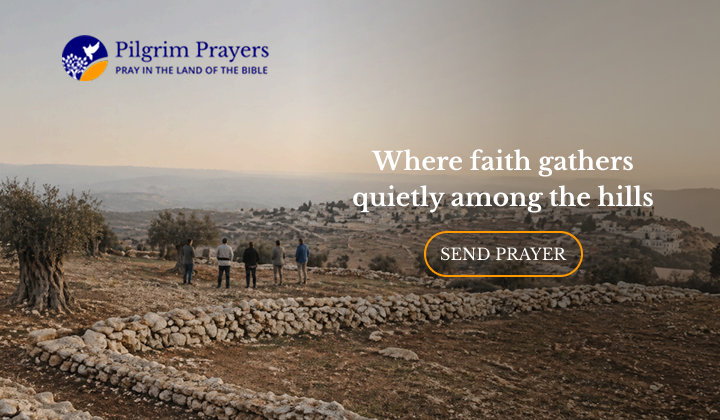
Beit Sahour sits on the eastern edge of Bethlehem, where the land opens up and the Judean hills slope toward the desert. The fields are not dramatic. No towering cliff, no ceremonial arch, no ancient column. Just sloping limestone and old terrace walls, olive trees in the lower ground, the sky enormous overhead.
These are, by tradition, the fields where the shepherds were keeping watch.
And this week, the lectionary gives us back the shepherd.
Not the miracle worker. Not the teacher at the temple steps. The shepherd.
“He calls his own sheep by name and leads them out. When he has brought out all his own, he goes ahead of them, and the sheep follow him because they know his voice.” (John 10:3-4)
The Fourth Sunday of Easter is always Good Shepherd Sunday.
A quiet faith shaped by listening and community
It arrives, year after year, right in the middle of Eastertide, when the first brightness of resurrection has quieted, and the disciples are beginning to ask what “he is risen” means for ordinary weeks. The answer the lectionary offers is not an instruction. It is an image.
A shepherd who knows each one by name. Who goes ahead, not behind. Who the sheep recognize not by sight but by the sound of a voice they already know.
The early community in Jerusalem understood that image from the inside. Acts 2:42 describes what they did with it:
“They devoted themselves to the apostles’ teaching and to fellowship, to the breaking of bread and to prayer.”
No extraordinary signs listed. No miracles named. Just the community keeping its daily habits. Showing up. Gathering around the same voice, the same table, the same rhythm of prayer.
That is what new beginnings in community look like.
Not a dramatic restart. A quiet choice to keep gathering.
In today’s world, even those far from these hills find ways to stay connected; some choose to submit prayer requests or intentions as part of a shared rhythm of faith and remembrance.
There is still a Christian community in the villages around Bethlehem.
Smaller now than a generation ago. Fewer families in the old neighborhoods of Beit Sahour and Beit Jala. More young people who have made their lives elsewhere.
But still there. Still gathering. Still marking the feasts of the liturgical year in the same hills where Psalm 23 was not a framed verse on a wall but a daily description of what it means to live on hard ground and trust the shepherd’s provision.
“Even though I walk through the valley of the shadow of death, I will fear no evil, for you are with me.” (Psalm 23:4)
Psalm 23 was written for exactly this kind of season. Not triumph. Not revival. Just the sustained, quiet conviction that the shepherd has not abandoned the field.
The shepherd still leads, the field still waits
Standing in Shepherd’s Fields does not ask you to produce a stronger faith.
It asks you to listen.
Whose voice are you following this week? Which community are you still showing up to, and who is still showing up for you?
The Good Shepherd does not drive the flock from behind. He goes ahead. That means the path has already been walked. Even the path that runs through the valley.
You can stand with the community still gathered in those hills.
We will carry your prayer to the holy sites of the Holy Land, received as a holy trust and brought before God on your behalf.
For those unable to be here physically, an online prayer request becomes a quiet way to join in that same space of faith, trust, and remembrance.
Some choose to include a small offering and receive a personal photo or video from the moment their prayer is placed.
👉 Submit your prayer for the Holy Land community
The field still waits.
And the shepherd still calls.