
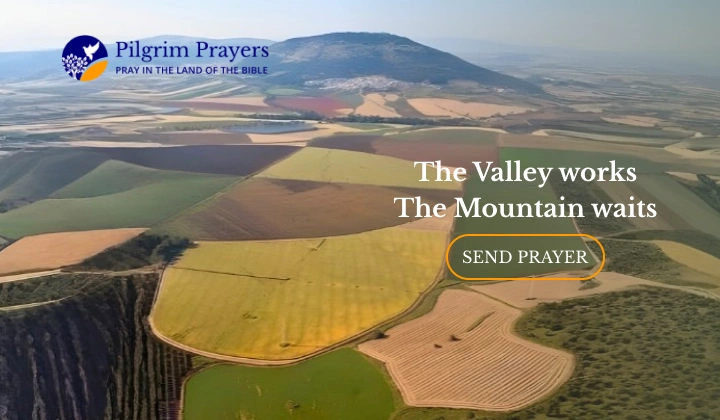
The valley works. The mountain waits. And in between – your prayers.
Stand at the foot of Mount Tabor in the Lower Galilee, and you feel it immediately: a pull in two directions at once.
Below you, the Jezreel Valley – one of the most fertile stretches of land in the Middle East – spreads wide and golden. Farmers work. Tractors move through fields. Life happens here, ordinary and essential, the kind of daily labor that puts bread on tables and fruit in markets. This is the ground that feeds people.
Above you, rising 575 meters (1,886 feet) out of the valley floor, Mount Tabor lifts toward the sky. Quiet. Ancient. Set apart.
Our friend Uri stood at this very threshold recently – one foot in the valley, one eye on the summit – and put words to something every pilgrim eventually feels:
“This mountain reflects the tension between real life and holiness.”
He’s right. And it’s a tension this particular piece of earth has held for longer than almost anywhere else on the planet.
What this Valley has witnessed
The Jezreel Valley is not a peaceful place by history.
It is, in fact, one of the most fought-over corridors in human memory. The Egyptians crossed it. The Canaanites defended it. Here, Deborah and Barak gathered their forces against Sisera’s iron chariots (Judges 4). Here, Gideon’s three hundred men descended with torches hidden in clay jars. Here, King Josiah fell at Megiddo. Here, the Crusaders and Mamluks clashed for centuries. Here, Napoleon broke his Egyptian campaign. Here, the British under Allenby ended the Ottoman hold on the Holy Land in 1918.
And above all of this history, unchanged, unmoved – Mount Tabor stood.
Because it is on this mountain, most Christian tradition holds, that the Transfiguration occurred. Jesus climbed with Peter, James, and John. And on the summit, something the valley could not contain broke through: “His face shone like the sun, and his clothes became white as the light” (Matthew 17:2). Moses and Elijah appeared. A voice came from a bright cloud. The ordinary world of the valley fell away, and the disciples glimpsed something they had no words for.
The mountain didn’t stop the valley from being a battlefield. It never has.
But it offered something the valley couldn’t: a place to see from above. A place to encounter the holy in the middle of the human.
The Valley is contested again
If you visit the Jezreel Valley today – if you stand where Uri stood – you will see farmers still working. The soil still yields. The harvest still comes.
But the northern region of Israel is, again, under the shadow of conflict. Rockets have fallen on Galilee communities. Families have taken shelter in safe rooms and underground shelters. The ancient rhythm of sowing and reaping has been interrupted by sirens and the weight of uncertainty. The valley that has fed people for millennia is now, once more, a place where people need to be prayed for.
This is not distant news for those who love this land and its people.
And it is precisely here – in this collision of sacred history and raw present reality – that Uri’s invitation becomes not just poetic, but urgent:
“We’re trying to bring together this meeting place between your Bible Land prayer requests and between real life, where you can touch the ground, and between where you want to ascend up there in the mountain.”
The transfiguration was not an escape
Here is what the story of the Transfiguration does not say:
It does not say the disciples went up the mountain and decided to stay.
Peter, caught up in the glory, suggested building three shelters – one for Jesus, one for Moses, one for Elijah. He wanted to hold the moment, to make the holy permanent, to stay above the broken world below.
But they came back down the mountain. They walked back into the valley. And the very next scene in Matthew’s account is a father, desperate, crying out for his suffering child.
The mountaintop was never meant to replace the valley. It was meant to equip those who would return to it.
This is what prayer does for us. It does not lift us out of the difficult realities of our lives – or out of the difficult realities of a land under threat. It lifts our vision long enough to return with the strength we did not have before.
A prayer for the Jezreel Valley and its people
If this reflection has moved something in you, we invite you to pause – wherever you are – and pray.
Lord of this ancient land,
you have watched this valley for thousands of years.
You have seen it at harvest and at war,
in peace and in grief.
Today we lift before you the people of northern Israel –
those who are afraid, those who have taken shelter,
those who tend fields not knowing if they’ll see the harvest,
those who listen for sirens before they sleep.
Let your peace – not the peace the world gives, but yours –
settle over the Jezreel Valley.
Protect the vulnerable. Comfort the grieving.
Guide toward peace those with the power to make it.
And for us, your people far away:
help us not to watch from a safe distance
without climbing the mountain in prayer.
We ascend on their behalf.
Amen.
Come and stand at the Threshold
Uri is extending an invitation – not just to visit a place, but to experience something that this valley has been teaching pilgrims for centuries: that real life and holiness are not opposites. They are conversation partners. The daily ground and the sacred summit need each other.
With Pilgrim Prayers, you can send prayer requests to Jerusalem – to the heart of this land – and submit them at the holy sites on your behalf. If the people of the Galilee, the northern communities, and the peace of this ancient valley are on your heart, we would be honored to bring your prayer there.
The valley is real. The mountain is there. Your prayers matter here.