
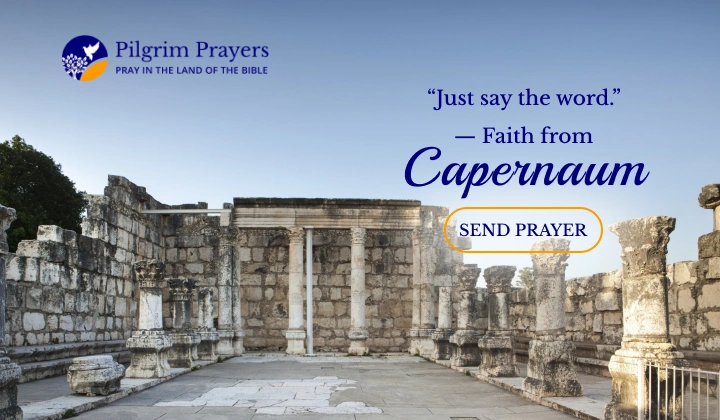
The ancient basalt synagogue ruins at Capernaum in early morning light, stone columns casting long shadows toward the Sea of Galilee visible in the background]
The basalt stones of Capernaum are cool before sunrise and warm by mid-morning. You walk across them before the tour groups arrive, and the ruins of a first-century synagogue rise around you. Fish and anchor carvings, worn nearly smooth by time and weather. The Sea of Galilee glinting a quarter mile beyond the reeds.
This was the city where Jesus lived. Matthew 4 calls it his own town, his working base on the northern shore. He healed here. He taught here. He called fishermen away from their nets on this shoreline. And in Luke 7, a Roman soldier trusted him from a distance here.
The centurion had a servant who was dying. He held authority over a hundred men, a garrison in an occupied territory. He could issue orders and see them carried out. But not for this. Not for this kind of dying.
He sent Jewish elders to Jesus first. These were men who could vouch for him: “He is worthy. He loves our nation. He built our synagogue.” The ruin you stand in may rest on that same foundation. Jesus set out toward the house.
Then a second message arrived. More messengers, this time sent by the centurion himself:
“Lord, do not trouble yourself. I am not worthy to have you come under my roof. That is why I did not presume to come to you myself. But say the word, and let my servant be healed. For I too am a man set under authority, with soldiers under me, and I say to one, ‘Go,’ and he goes. Just say the word.”
Use this Prayer
Say the word.
He understood something that people who walked with Jesus every day were still working out. He understood authority. He understood that power does not need proximity to act. He did not need Jesus to walk through his door. He needed Jesus to speak.
Jesus called it the greatest faith he had found in Israel.
Faith that did not need distance removed
Today is Ascension Day. Ten days ago, by the church calendar’s reckoning, the disciples stood on the Mount of Olives and watched Jesus lifted beyond their sight. They walked back to Jerusalem in silence and went to the upper room. They waited.
That waiting was not passive. Acts 1 says they devoted themselves to prayer, all of them together, in one place. They prayed the way the centurion prayed: with full trust in an authority they could no longer see directly, asking for something only that authority could give.
Ten days from now is Pentecost. The disciples did not know exactly what was coming. They knew the promise. They held to it. They asked.
This is the posture the church is in right now, and it is the same posture you hold whenever you send a prayer request for Israel from a distance.
Waiting in prayer between ascension and Pentecost
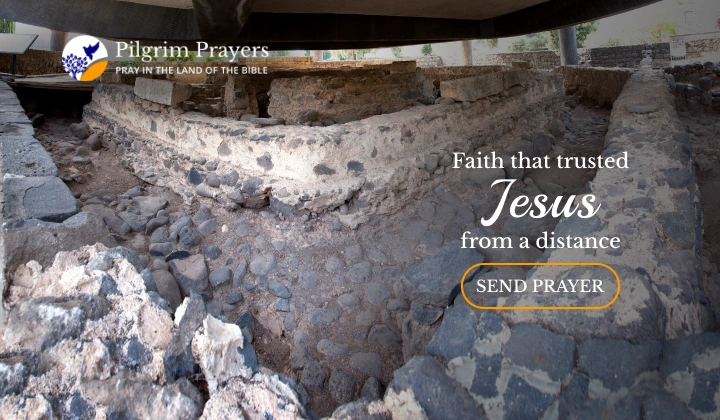
Most people in this community will never stand on these basalt stones. You will not walk the street in Capernaum where the centurion’s servant was healed. You are praying from wherever you are, for a land you may never touch.
That is not a limitation. According to Luke 7, it is a form of faith.
More than ten thousand Christians are living and worshiping in Jerusalem today. Many of them are navigating real difficulty: harassment in the streets, hostility in their neighborhoods, the daily weight of being a visible minority community in a complicated city. Their churches are open. Their morning prayers still rise. They are not waiting for conditions to improve before they pray. They are praying in difficult conditions.
They are the centurion’s household. They are holding ground and trusting. And in their own way, they are asking the same thing that the soldier asked on a street two thousand years ago.
Just say the word.
Praying for Jerusalem from wherever you are
You do not need to be in Jerusalem to pray for Jerusalem. You do not need a pilgrim’s passport, a plane ticket, or fluency in another language. You need what the centurion had: a clear sense of whose authority you are trusting, and the willingness to ask.
This week, between Ascension and Pentecost, the whole church is in that posture. Waiting. Trusting. Praying.
You are not alone in it.
Bring the person, the situation, and the place in the Land of the Bible you have been carrying. Send prayer request to Jerusalem below. Our team prays over every request.