
Today in Jerusalem stories, Uri stands on the slopes of the Mount of Olives, overlooking the Old City of Jerusalem, just above Dominus Flevit. From this quiet hillside, he invites us to pause and to see Jerusalem as Jesus saw it nearly 2,000 years ago.
Before Him lay the Temple Mount, the ancient walls, and the Kidron Valley below. This was the eastern entrance to Jerusalem, the road every pilgrim walked when ascending to worship. It was the place where hope rose with every step toward the Temple. It was also the place where Jesus stopped, looked at the city He loved, and wept.
“When He approached Jerusalem and saw the city, He wept over it.” Luke 19:41
These tears were not sudden. They were born of knowledge, love, and deep sorrow.
Uri explores the view Jesus saw from the Mount of Olives
The Mount of Olives in the days of Jesus
In the days of Jesus, the Mount of Olives was covered with ancient olive trees and offered a clear, commanding view of Jerusalem. From here, the Temple stood radiant in white stone and gold, the spiritual center of Jewish life and the dwelling place of God’s presence among His people.
This was the route Jesus took during the Triumphal Entry, fulfilling the words of the prophet Zechariah that Israel’s King would come humble and riding on a donkey. Crowds welcomed Him with praise, unaware that within days their shouts would fade.
Luke tells us that after the celebration, Jesus paused on this very slope. He looked upon Jerusalem and saw beyond the present moment. He foresaw suffering, siege, and destruction. He knew the city would soon face judgment because it did not recognize the time of God’s visitation.
Why Jesus wept
Jesus’ tears were not a sign of weakness. They were the expression of divine love joined with prophetic truth. He wept because Jerusalem was called to be a city of peace, yet it was moving toward devastation.
Within one generation, His words would come to pass. In AD 70, Roman armies destroyed the city and the Temple. But Jesus’ grief went deeper than buildings and stones. He mourned hearts that could not see what God was offering them.
His longing was personal. He desired to gather His people, to shelter them, to lead them into peace. His tears reveal the heart of God toward Jerusalem and toward every generation that resists His call while still being loved by Him.
Dominus Flevit: the Church of Tears
Dominus Flevit, meaning “The Lord Wept,” stands today as a witness to this moment. Built in the twentieth century, its tear-shaped design reflects Christ’s sorrow. The window behind the altar frames the Old City, inviting visitors to look upon Jerusalem through the same line of sight as Jesus.
Beneath the church are tombs from the Second Temple period, silent testimony that this hillside belongs to the world Jesus knew. Stone, earth, and Scripture meet here.
A view that still speaks today
The Mount of Olives is not only a place of tears. It is also a place of promise. Scripture tells us that Jesus ascended into heaven from this mountain, and that He will return in the same way.
Here, sorrow and hope stand side by side. Judgment and mercy meet. The place where Jesus wept is also the place that points toward restoration.
As Jerusalem once again stands at the center of global attention, this view continues to call believers to prayer, humility, and compassion. It asks us whether we recognize the ways of peace in our own time.
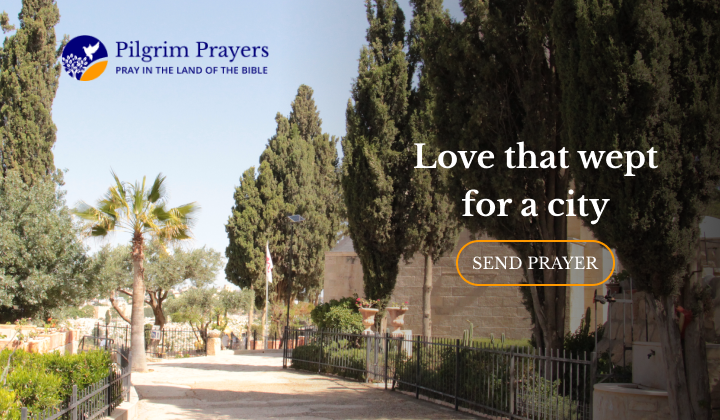
Lift Your Prayer from the Place of Jesus’ Tears
From the Mount of Olives, Jesus wept for Jerusalem and for hearts in need of peace. Place your prayers before Him, trusting His mercy still meets us there.
Send your prayer from the Mount of Olives
When you send a prayer request online to the Mount of Olives through Pilgrims Prayers, you are uniting your heart with the place where Jesus wept for Jerusalem. Your biblical site prayers rise from a hillside marked by prophecy, compassion, and God’s unfolding plan.
Sending Mount of Olives prayer requests allow you to pray with deeper biblical awareness and spiritual alignment. It invites you to stand, in faith, where Jesus stood, interceding for Jerusalem and opening your own life to the peace He still longs to give.