
A reflection for Eastertide
It was still dark when they went out.
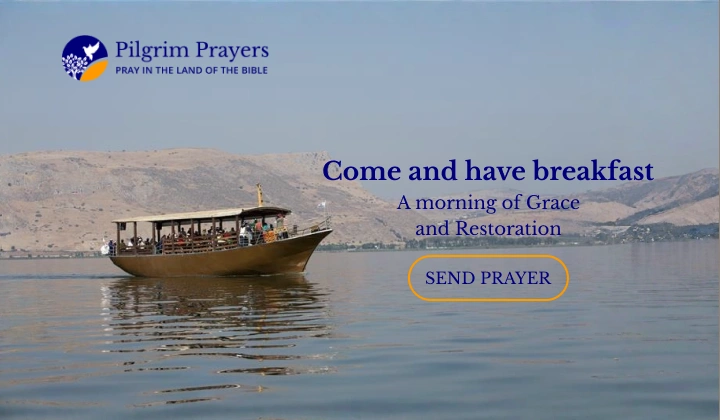
Peter, Thomas, Nathanael, James, John, and two others. Seven men in a wooden boat on the Sea of Galilee, doing what several of them had done long before Jesus ever called them. Going back to the water. Going back to the work of their hands.
Easter had come and gone. The resurrection was real. The appearances had happened. But it was not yet clear what to do next.
They fished all night and caught nothing.
As dawn broke, a figure appeared on the shore about a hundred yards away. He called out to them across the water: had they caught anything?
No.
Throw the net to the right side of the boat. The net fills so fast that they cannot haul it in. Peter recognizes him. He wraps his outer garment around himself and jumps into the water. The others follow in the boat, dragging the heavy net to shore.
They arrive and find something they did not expect.
Not a vision. Not a teaching. A charcoal fire already lit, with fish on it, and bread.
“Come and have breakfast,” Jesus says. (John 21:12)
This is one of the most quietly extraordinary scenes in the New Testament.
The disciples are not on a mountaintop. They are not in a prayer meeting. They are standing on a beach at dawn, soaking wet, having failed all night at the one thing they thought they still knew how to do. And Jesus is already there, with the fire going and the meal prepared.
“He takes the bread and gives it to them. The fish, too.” (John 21:13)
Then, after they eat, he turns to Peter. Three times he asks the same question. Do you love me? Three times Peter says yes. Three times Jesus gives him a commission: feed my lambs, tend my sheep, follow me.
Three denials. Three restorations. Both at a charcoal fire. It is the only other charcoal fire in John’s Gospel, and the echo is deliberate.
Peter is not given a lecture on failure. He is given breakfast. Then a question. Then a purpose.
Community is rebuilt over a meal on the shore of a lake.
Uri is an Israeli standing at the edge of this same lake. The water has receded. The shoreline behind him shows the pale markings of drought. It is not an easy sight, he says. It reminds him not to take abundance for granted.
And then: keep praying till we get a better day.
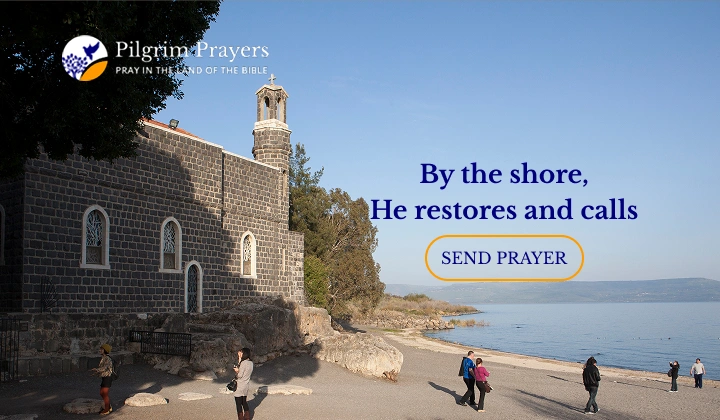
The Church of the Primacy of Peter stands at Tabgha, on the northwest shore of this same lake, tended year-round by a small Franciscan community. Inside, built into the chapel floor, is a large flat basalt rock known as the Mensa Christi, the Table of Christ. Tradition holds this is the rock on which Jesus laid the fish and bread that morning.
Pilgrims have not come this spring. The conflict with Iran has kept most visitors away from Israel’s holy sites. And the north carries a weight of its own: the communities along the Galilee have lived under security threat, with residents in some areas spending long stretches in shelters, far from the lake that their region is named for.
The lakeshore is quieter than it has been in years, and not only because of drought.
But Uri is there. The Franciscans are there. The lake is still there, even at low water, even under threat.
This week, Israel observed Yom HaShoah, Holocaust Remembrance Day. In the days ahead: Yom HaZikaron, the memorial day for fallen soldiers, on April 21, and Yom HaAtzmaut, the celebration of 78 years of Israeli nationhood, on April 22. A sequence that moves from grief to memory to hope, observed this year under rocket sirens and the weight of an ongoing war.
Christians who pray for Israel are not the owners of that story. But Scripture calls us to stand alongside the Jewish people in their sorrow and their hope. To say, as the Psalmist said, “pray for the peace of Jerusalem” (Psalm 122:6), and to mean it in seasons of drought, threat, and long waiting.
A prayer for this week
Lord,
We think of seven men arriving at the shore empty-handed, and finding that you had already lit the fire and prepared the meal.
We pray for Israel this week, for the Jewish people who have moved through grief and memory and hope these past days. For people who know what it means to move from death toward life.
We pray for the quiet shores of Galilee, and for the community at Tabgha still tending the stone.
Come to wherever we are. Come to Jerusalem.
Amen.
The basalt rock at Tabgha has been there for two thousand years. The Franciscans are still there. The shore is still there.
Your prayer for Israel can reach that lakeshore and Jerusalem, from wherever you are standing.
Pilgrim Prayers carries intercession to Jerusalem and submits it at the holy sites on your behalf. Every prayer is received in Israel and treated as a holy trust.
Submit your prayer request for Israel this week.
“Come and have breakfast.” John 21:12