
“Blessed are the peacemakers, for they shall be called children of God.” – Matthew 5:9
As we look around our world today, we’re met with a sobering truth: peace feels distant. From the headlines of war and unrest to the quiet heartbreaks unfolding in homes and hearts, the world feels torn, frayed at the edges, and aching for restoration.
Here in the Land of the Bible, the need for peace is not theoretical. It’s deeply personal. Jerusalem itself – so often called the City of Peace – has known centuries of beauty and brokenness side by side. These days, it carries fresh wounds. The olive trees of Gethsemane still stand, silent witnesses to grief and to grace. The Western Wall holds the whispered prayers of generations. The air is heavy with longing – not just for safety, but for shalom: wholeness, healing, and holiness.
And yet, this is exactly where Jesus chose to walk. To weep. To pray.
What Shalom really means: more than just peace
Most people translate the Hebrew word shalom simply as “peace.” But that translation captures only a fraction of what the word actually means in Scripture.
Shalom comes from the root shalem, meaning complete, whole, or finished. When the Bible speaks of shalom, it is describing a state in which nothing is broken, nothing is missing, and nothing is out of place. It is not merely the absence of war. It is the presence of wholeness.
Consider a few of the ways shalom appears throughout Scripture:
- In Genesis 43:27, Joseph asks about his father: “Is your father well?” The word translated “well” is shalom. Health and flourishing are built into its meaning.
- In Numbers 6:26, the Aaronic blessing closes with: “The Lord lift up His countenance upon you and give you peace.” That final word is shalom. It is relational wholeness between God and humanity.
- In Isaiah 53:5, the prophet declares: “the punishment that brought us peace was on him.” The word is again shalom. Here it points to atonement, the restoration of what was broken between a holy God and a fallen world.
When Jesus is called the Prince of Peace in Isaiah 9:6, the title is not merely poetic. He is the Prince of Shalom, the one who came to make whole everything that sin had fractured: our relationship with God, with one another, and with ourselves.
That is the peace we pray for. Not simply a ceasefire. But wholeness.
Why the Western Wall? A brief history of whispered prayers
The Western Wall, known in Hebrew as the Kotel, is the last remaining retaining wall of the Second Temple in Jerusalem, the holiest accessible site in Judaism and one of the most sacred locations in the Christian world.
After the Temple’s destruction in 70 CE, Jewish communities scattered across the world continued to face Jerusalem in prayer three times a day, fulfilling the tradition rooted in Daniel 6:10. The Wall became the physical point toward which those prayers were directed.
The practice of placing written prayers, called kvitlakh in Yiddish or pitkaot in Hebrew, between the ancient stones is centuries old. Notes are collected twice a year and given a dignified burial on the Mount of Olives, following the Jewish tradition that sacred writings containing God’s name must not simply be discarded.
Today, more than one million handwritten prayer notes are placed in the Wall annually, from visitors and pilgrims and people who have sent their prayers from every corner of the world.
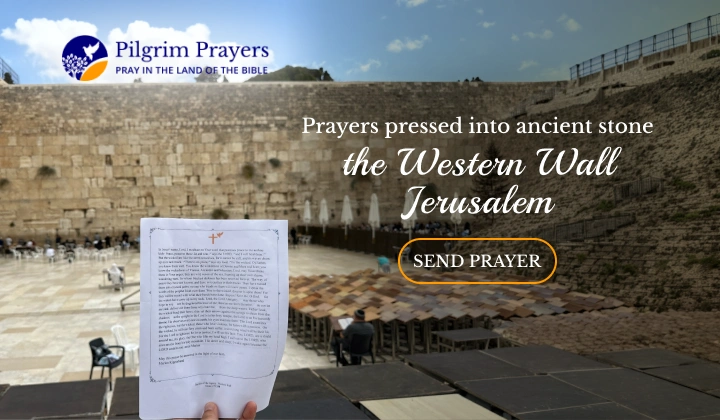
This is the sacred practice that Pilgrim Prayers continues. When you submit your Western Wall prayer request, Dr. Rivers and the Pilgrim Prayers team print it and personally carry it to the Wall, placing it between those ancient stones. Your prayer, written on paper, rests in the same crevices where generations have brought their grief, their hope, and their longing for shalom.
A reflection from Jerusalem
In Matthew 5:9, Jesus doesn’t just admire peacemakers. He calls them His own. “Blessed are the peacemakers, for they shall be called children of God.” Not the powerful. Not the popular. The peacemakers.
To be a peacemaker doesn’t mean we can fix the world. But it does mean we bring it, in all its brokenness, to the One who can.
From here in Jerusalem, the place where Jesus walked and prayed, we’re standing with you in faith. We’ll bring your prayer to the Western Wall, laying it gently between the stones, where generations have come seeking hope and wholeness.
A micro-devotional for your week
The scripture
“Blessed are the peacemakers, for they shall be called children of God.” – Matthew 5:9
The reflection
Peace begins not in parliaments but in persons. Jesus did not say, “Blessed are the peacekeepers,” those who simply avoid conflict. He said “peacemakers”: those who actively pursue shalom, who step into broken situations and carry wholeness with them. That is a calling, not a personality trait. It is available to every believer, wherever they are today.
The breath prayer
“Prince of Peace, bring shalom to my heart and to my world.”
Repeat this slowly, morning and evening this week. Breathe in on “Prince of Peace.” Breathe out on “bring shalom.” Let it settle.
The action step
This week, reach out to one person with whom you have an unresolved tension, even a small one. You do not need to resolve everything. Simply make contact. Send a message. Say you’ve been thinking of them. That small act is the beginning of shalom.
You are not praying alone
One of the most isolating feelings in a broken world is the sense that we are grieving or hoping alone. We are not.
This week, prayers for peace have been submitted to Pilgrim Prayers from people across the globe. Though each prayer is personal and private, together they form something larger: a global chorus of voices lifting the same longing to the same God, from the same ancient Wall.
So this week, we invite you to join us in prayer. Wherever you are, in joy or in pain, in certainty or confusion, lift your voice to the Prince of Peace. Join the countless believers who are praying not just for change, but for deep, soul-level shalom in our world.
Send your prayer to the Western Wall today. Your prayer will be personally printed and placed between the ancient stones of the Western Wall in Jerusalem. Free. Sacred. Real.
Let your voice be part of a movement of healing, from homes to nations, from heartbreak to hope.
Frequently asked questions
1. What does shalom mean in the Bible?
Shalom is the Hebrew word most often translated as “peace,” but its meaning is far richer. Rooted in the word shalem, meaning complete or whole, shalom describes a state in which nothing is broken, nothing is missing, and all relationships, with God, with others, and within oneself, are whole. True biblical peace is not the absence of conflict but the presence of wholeness.
2. Why do people place prayers at the Western Wall?
The practice of placing written prayers in the crevices of the Western Wall has roots going back several centuries. The Wall is the last remnant of the Second Temple compound and the holiest accessible site in Jerusalem. Believers bring their prayers here because it is the place where heaven and earth feel closest. Pilgrim Prayers continues this tradition by physically carrying your submitted prayer to the Wall.
3. How does Pilgrim Prayers place my prayer at the Western Wall?
When you submit a prayer through the Pilgrim Prayers website, the team prints your request and Dr. Rivers or a trusted member of the team personally carries it to the Western Wall in Jerusalem. Your prayer is placed between the stones, exactly as pilgrims have done for generations. Notes are later given a respectful burial on the Mount of Olives, in keeping with Jewish tradition for sacred writings.
4. Is there a cost to send my prayer?
No. Submitting your prayer to Pilgrim Prayers is completely free. The ministry is supported by those who choose to give, but placing your prayer at the Wall costs you nothing.
5. What does it mean to be a peacemaker in Matthew 5:9?
In the Beatitudes, Jesus calls peacemakers blessed and says they will be called children of God. He uses the Greek word eirenopoios, which means one who actively makes peace, not simply one who avoids conflict. A peacemaker pursues shalom, brings wholeness into fractured situations, and reflects the character of God. It is a calling available to every believer, regardless of position or influence.